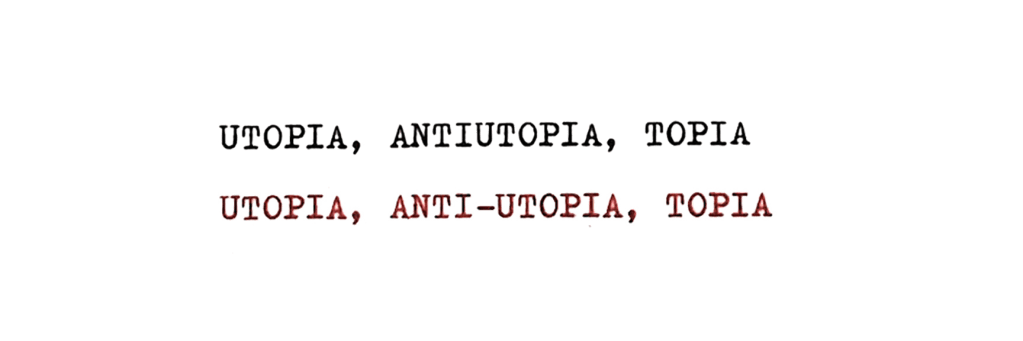
Translated from “Utopia, Antiutopia, Topia” by Superstudio; Originally published in “in, argomenti e immagini di Design”, N.7, 1972.
Translation [draft]
Where do you think you’re going on the road to utopia? Is it that you are truly convinced this is the way of salvation from the errors and pain that surround us? Do you no longer remember that this road is as long as the life of humanity and no one has ever found a landing place on it? Do you not see that its light is illusory; that the countries encountered are those dreamed; that the lakes seen from it are deceptive destinations, mirages caused by the ferocious heat of the sun? Where will you find dreams on this road, the strength to awaken men from the nightmare of reality? Where will you look for them? In the fatigue of fairy tales told around fireplaces; or in the dormancy of travel stories read at the bottom of a glass; or maybe you hope to find them in the social mechanical abstractions, madly distilled by inks?
Seeking salvation in utopia is the sublimation1 of utopia.
You too run towards the star, believing it to be the light from a distant home like the child lost in the forest in fairy tales.
Utopia has always been for man the distant blink of a star, a source of illusory hopes and unattainable dreams; and a screen against the horror of reality, which alone can generate the determination to seek the way to salvation.
So only in horror is there hope. And the Power has always
known its strength and with it, it has created innumerable Hells to reach forth like swords against it enemies hidden behind the shields of their utopias.
In the slumber of betel, opium, coca or peyote, one sleeps happily, forgetting hunger and pain, in the vision of the magical El Dorado, of the happy phantom island of Antilia, of the plentiful lands of Cockaigne or of the serene fields of Armonia. In this dream we want to introduce the “larvae” of Averno and the slimey “nightmares” of Bosch, the infernal demons and monsters of distant countries and stars. We thus hope to provoke awakening; even if it is in scream and cold sweat, everyone will be reborn in their own anguished reality to at least decide i f they want to fight or prefer to let themselves die.
In anti-utopia we feed the little monsters that creep and coil in the dark recesses of our homes, in the dirty corners of our streets, in the folds of our clothes, and even in the mystery of our brains. In the cradle of anti-utopia we try to make them grow until they become enormous, and dust and darkness can no longer hide them, so that everyone, even the most short-sighted, can see them, huge Kafkaesque cockroaches, in all their most monstrous details.
We therefore refuse to cultivate utopias, impossible flowers without fragrance, fragile and delicate to be kept under glass bells.
Instead we prefer to be shepherds of monsters; evoking them from within our magical circle, we look after them and feed them so that they grow big and run around unleashed.
Because we know that our terrible monsters are only made of smoke, while the fragile red flower cultivated by the utopians is like the poppy that hides in its corolla the white latex of slumber; and this truly frightens us.
Utopia: “A place that does not exist . An imaginary social and political order in which everyone is happy” (The New Melzi Dictionary, 1926).
Topia: “Existing reality” (Karl Mannheim, Ideology and Utopia, 1957).
Anti-utopia: “A place and socio-political order, which one hopes will never come true, imagined in a cathartic function” (Superstudio, 1971).
Notes
- (In Freudian context) ↩︎
TypeScript
References
Superstudio. Superstudio Opere : 1966-1978. Edited by Gabriele Mastrigli, 2016.
This post contains material that is believed to be protected under the doctrine of fair use. The use of this material is for scholarship and research.
 Jingqi Kay Liu
Leave a comment