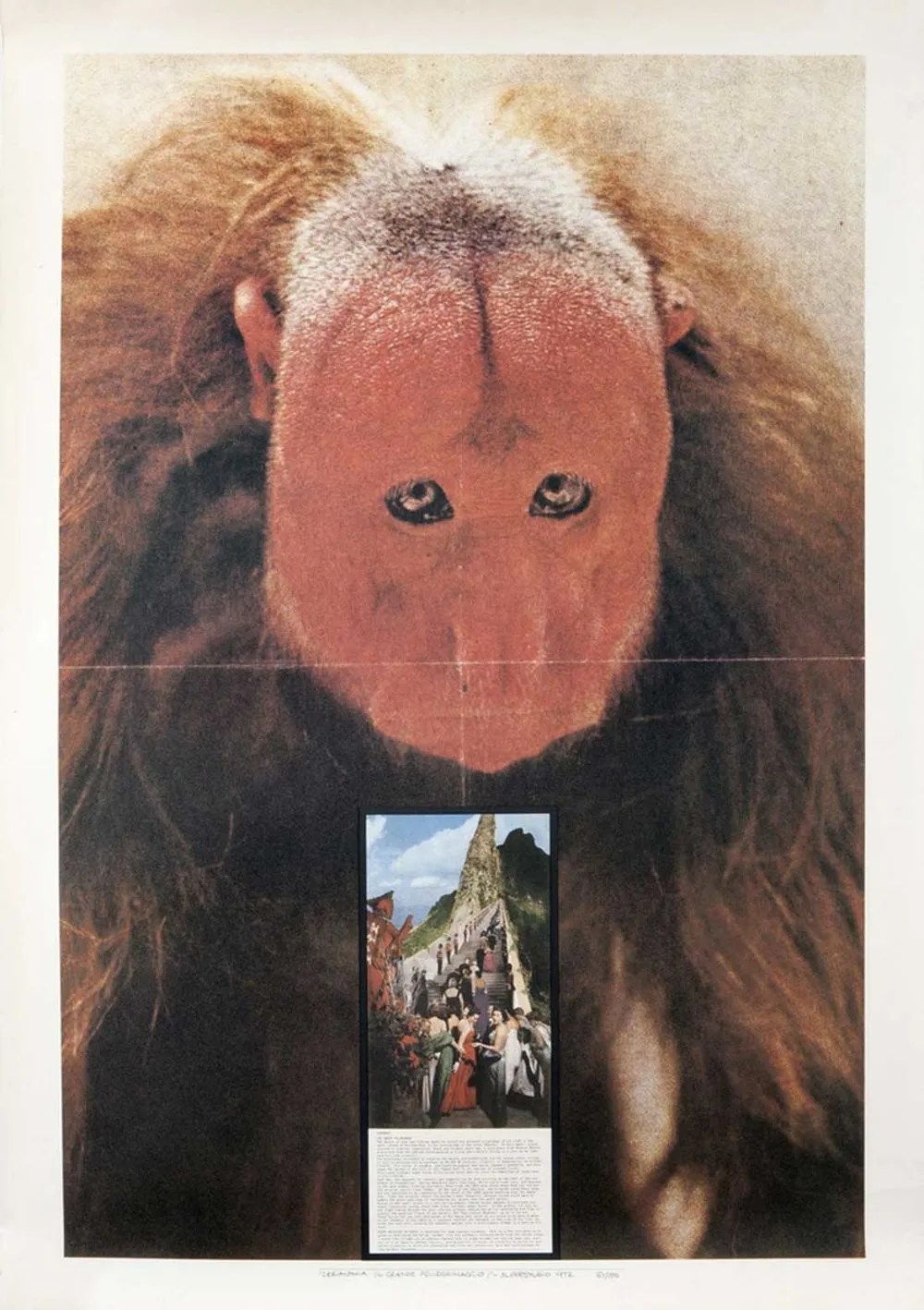
Translated from “Vita, Educazione, Cerimonia, Amore, Morte: cinque storie del Superstudio, 3 [Cerimonia]” by Superstudio; Originally published in “Casabella”, N.374, 1972
The Total Ceremony
Don’t smile at the child hopping along the school road as they try to avoid stepping on the pavement joints: they are probably inventing a ritual.
Durkheim defines ritual as: “Rules of conduct that prescribe how humans should behave with sacred things.”
A few pages earlier, it was specified that there exists: “A large number of rituals completely independent of any ideas of gods or spiritual beings. First of all, there is a large number of prohibitions. The Bible (…) prohibits yoking together donkeys and horses, or wearing a garment made of a mix
of hemp and flax (…). The same can be said about most of the dietary prohibitions. And these restrictions are by no means unique to the Jews, but are found in different forms, with the same characteristics, in innumerable religions (…).”
(These rituals) operates on their own, without depending on any divine power for their effectiveness; they mechanically woke the effects that constitute their reason of being.” And he concludes: “This religious formalism, which is probably the earliest form of juridical formalism, arises from the fact that the formula to be uttered and the movements to be performed, hawing in themselves the origin of their own effectiveness, would lose it if they were not exactly in conformity with the type consecrated by success. ‘Thus, there are rituals without gods, and even rituals from which gods are derived… religion therefore transcends the idea of gods or spirits, and therefore cannot be defined in exclusive terms of these’.”
Ritual, therefore, is not so closely linked to the relationship between human and deity as is commonly believed: “Ritual – A norm, established by the religious tradition that regulates the performance of a sacred action in a way that is effective in establishing communication between humans (individual or group) and divinity” dictionary defines it as such.
Ritual is rather linked to the more generic concept of the sacred, of the transcendent. And what is the transcendent? “Everything that exists outside and above another reality, one that it depends on.”
For the child on their way to school, the transcendent is the teacher, or rather, the authority of the teacher; they do not know where it comes from, but it conditions their whole life, even in their relationships with the parents; it is the mysterious entity that sets orders and prohibitions according to mysterious criteria; that can make them suddenly feel terribly unhappy. And they exorcise this entity by inventing a ritual to reassure themselves, perhaps because yesterday they played the same game on the way to school and did not get quizzed. “A ceremonial act is established as a defensive or assurance behavior, as a protective measure.”
This will continue to repeat itself for all their life
as soon as they step out of their “own reality” into the treacherous terrain where logical links between things become unclear to them. They will never come to understand why those others have power over them, where that power comes from, and how that power will manifest towards them. Their knowledge of the mechanisms of domination is, when it exists, too superficial and too extraneous from their experience to provide them with a profound understanding of the logic of power. And mystery always instills fear, while only awareness of one’s own possibilities can give birth to confidence in one’s own strength.
This is why each of us, in our relations with others, with their expected or presumed power, uses rituals that the Culture provides, or that they themselves have invented and tested. Since using them means admitting one’s own weakness and fear, one’s own shame of feeling enslaved, we delegate this awareness to the unconscious, and convince ourselves that this way of acting is the only possibility, that it must be done this way.
“The social environment appears to us entirely populated with forces, which in reality only exists in our minds. ‘We know what the flag means to the soldier; yet in itself, it is just a piece of fabric. Human blood is an organic fluid; nevertheless, even today, we cannot see it flowing without experiencing a violent emotion, inexplicable on the basis of its physical and chemical properties’.”
Our entire life is therefore a set of rituals; better yet, since the term ritual remains in common language overly tied to
the concept of religion, we will use the term “ceremony”, which also admits secular implications (military ceremony, State ceremonial, being ceremonious…); our life is essentially an uninterrupted ceremony from birth to death. It is difficult to accept this vision of our existence, but it is a given fact. Let’s observe for example how, in our interactions with people, we constantly employ ceremonial gestures, such as greetings, pleasantries, handshakes, hugs, etc.
It is clear that these are merely ritualistic, yet if we were to eliminate them completely, we would be physically unable to engage with others; nevertheless, these acts are not essential and wary over times and places. (Among the indigenous people of the Andaman Islands: “A unique form of ceremonial greeting is practiced when two friends or relatives reunite after a long separation: one of them seated on the ground, holds the other on their lap, and both embrace each other while crying unrestrained”).
This is only an epidermal and easily perceivable aspect of the ritual “continuum” that we live in; in reality, everything, even the most directly biological aspects of our existence (nutrition, excretion, sex…) are framed ceremonially and in such an ingrained way, that only a deliberate comparison with similar ceremonies of cultures distant from ours can provide us with the measure. However, do not believe that the “conception” of a ceremony is a casual occurrence; Freud demonstrated that every ritualistic act has a meaning and a logic, even if the “actor” has forgotten them or has buried them in the depths of eur their unconscious.
Anyone, reflecting on the ceremonial of approach between people, can realize that it adheres more to the rules of “etiquette” when the “actors” know less of each other, or when their “social distance” is greater; in practice, we cover our fear and thus our defensive-aggressive attitude towards the other under the guise of ritual. The sincerity of the approaching ceremony is inversely proportional to its formal rigor.
Unfortunately, it is not always so easy to penetrate the logic of our everyday ceremonial acts, but it can be shown that each of them has a precise and often disturbing meaning.
“With the help of psychoanalytic technique of investigation (…) that impression of stupidity and senselessness is completely eliminated, and the reasons for these phenomena are explained.” These words of Freud indeed refer to the analysis of obsessive neuroses, but he had specified shortly before: “We must not presume to find a clear distinction between ‘ceremonials’ and ‘obsessive behaviors’.”
In the concluding part of the same essay, Freud writes: “One could dare to consider obsessive neurosis as the pathological counterpart of the formation of religion, and to describe neurosis as an individual religiosity and religion as a universal obsessive neurosis.”
Thus the cycle is closed: we started from ritual as a link between human and divinity, we uncovered that it also extends to other acts that have nothing to do with religion, we saw how it permeates all the acts of our existence, even those we believed to be most spontaneous and natural, we returned to religion viewed as a collective neurosis.
We thus live our existence in a ceremonial framework bordering on neurosis; like the spider that moves only along the web it has spun itself, our freedom is an illusory movement along the wefts of our physical and mental ceremonies, with no hope of escaping them, because just attempting it would cause suffering from the senses of guilt, marginalization, rejection by others.
Do we then find ourselves fallen prey to an unstoppable mechanism? We believe not. Every colossus has its Achilles’ heel and it always rests upon it. Thus, the ritualistic comedy we are force into arises from our fear of the mystery of the dominating power, and the power is founded on our fear. Here is the Achilles’ heel, the crux of the tangled skein that is our ignorance.
“If the neurosis originated from culture is not opposed by a clear awareness of the problems, failed solution arises from it; in this case the human psyche responds with a series of unconscious defenses, that revert to archaic terms of “primitive” societies, in which ritual and magic responded precisely to the need of ensuring the personality of group elements against a ‘crisis of presence'(…).
The human condition in crisis paves the way (…) to becoming aware of the terms of the problem and to proposing reform projects, critical revisions, reworking of behavior models and their relative structures of organization and operation within society.”
The only solution to this farce of total ceremony is therefore not in the blind violence of the blowfly who hurls itself against the cobweb, without understanding its mechanism, remaining its captive instead of destroying it, but it lies solely in the analysis of each thread of its weft to recognize its meaning, to unmask the courses of force, and thus avoid the trap.
But let’s not delude ourselves. We will never be able to completely renounce our web because we can never invent our life day by day, moment by moment. However, we can transform the principal framework of our ceremonies de into conscious models of behavior, being aware of their meaning and limitations, thus mastering them; in this way, our web will no longer be just a trap of slimy threads to catch flies, but a steel framework along which we can move freely for a better understanding of the world and of ourselves.
The Happy Ones Who Build No Walls
They live by the seashore, they are mythical beings, kind and gentle; they are believed to be the only people who do not know any architecture. They live in huge pumpkins that grow on the brackish sand, and these serve as homes for them, as well as food and drink, light and warmth in winter days. In fact, by carving into the peel with their nails, they dig their shelters out of the pulp of these fruits; over the course of a year, as the pulp regrows inside, it nourishes them and quenches their thirst, while also emitting a gentle warmth; as they are always covered in its juices that oxidize in the air, they become phosphorescent, and their bodies are adorned with shimmering lights and iridescent colors.
These people know no sharp edges or heavy arches, possess no wrath and have no tools or any needs for them; they have only peace, joy, and and little desire; they also possess great imagination, no myths, only one simple rite.
At the end of summer, when the north winds begin to whiten the waves with froth, the simple and merry life that the tribe has led all summer fades away; silence descends upon all, as if everyone is trying to recognize the sound of the wind, and the only remaining voice are the calls of cliff birds preparing to depart for the south. And they leave at dawn, after the first night devoid of stories and songs that animated the vigils throughout the summer.
Thus comes the day of silence; the adults do not go out on that
day, but they send the children out, and the shaman searches in their silent games, in their eyes curious about the grey of sea and sky, for the signs that only they know; in the evening, they will choose the child who will be their helper in the rite.
The following day, the shamans and & the child search on the beach for the red tendrils of next year’s pumpkins; with patience and love, they seperate the tendrils; for each tendril, they leave only one flower, the most beautiful one; then carefully, they extract the roots and with their arms full of them, they set off to the locations where last year’s pumpkins died; here, they transplant the tendrils, one on the remain of each pumpkin, and with sea water they carry with their hands, they water them. When all is done, the shaman kneels in front of the child and offers them a pumpkin flower; with it, the little one runs towards the nearby grove and disappears into it; they will hide the flower in a secret place. The shaman awaits,standing on the deserted beach. When the child reappears, the shaman lets out a brief cry; upon hearing it, everyone goes out into the open and each heads towards one of the newly transplanted tendrils; they will care for them with love until the birth of new pumpkins, “even protecting the petals from the sea breeze with their own bodies in the early days” There is no record of any seedling that did not take root.
At the beginning of summer, the pumpkins have grown and are ready to be inhabited, while the ones used until then begin to dry out and soon collapse and crumbles under sun rays.
When an individual senses death nearing, they retreat into the
pumpkin and dies there;in a few days, the pulp, no longer being consumed, closes around the lifeless body.
It so happens when the shaman’s little helper has been chosen four times in previous years; they then do not run into the forest to hide the flower they have just been given, but to gather those that were given to them in the past; they show the flowers to the shaman, and from that moment, they abandon their mother and begin the apprenticeship that will lead them to become the new gardener of the tribe.
Los Esclavos1
A few hours by plane were enough to transport us from the full splendor of our summer to the white frost of land in the far south. We then seemed to have suddenly entered a realm of fairy tale, but soon this fairy tale revealed signs of madness.
We found the people whom we had come for; we saw the people who called themselves “los esclavos” – the slaves – working in silence without a smile among their houses: triangular parallelepiped structures with roof pitches extending down to the ground. And the village was the first thing that struck us. One hundred houses arranged in a perfect square, all identical and are separated by identical streets. In their brief summer, the houses certainly stood above a grassy plain, but then they appeared to us as a hole in the center, carving out the thickness of the snow, with walls compacted and smooth like crystal.
The life of this community, always composed of one hundred adults and almost as many children, is programmed from birth to death through an extremely rigid ritual, so ingrained in individuals by now that they don’t even realize they are performing it. Descendents, according to reliable hypotheses, from the slaves of a large farm, were so conditioned by the strictly organized life they had been forced into that they continued to repeat it even after their masters had disappeared. Each of them lives alone in a house; they adhere to precise schedules for eating and sleeping, and only during meals do they exchange conventional and useless conversations with each other. They mate every quarter of the moon; each man with the woman who lives in one of the adjoining houses, following a cycle that is completed every four generations. When the first child is born, all subsequent newborns of the same sex will be killed until one of the opposite sex is born; then the couple will have no more contact unless a child dies and thus needs to be replaced. Males are raised by fathers and females by mothers; they inherit the name and the house.
The women practice agriculture, and in their free time from farming, they make pottery and baskets; the men construct houses; all their work is rigidly ritualized: in teams of five mean, they demolish a row of houses every week and reconstruct them in such a way that every ten weeks, all the houses will have been rebuilt following very strict techniques, identical in every minor detail.
The work of the women is only seemingly more useful as they sow
and harvest according to ritualistic terms, which do not always coincide with the appropriate periods for planting and ripening. Even the baskets and pottery are made and unmade so that the work does not stop from dawn to dusk; this is the actual purpose of the ritual.
In fact, they have only one divinity, a negative entity which they call “Libertad” – Freedom, and for which they have an unimaginable terror; it is for exorcising this entity that they perform the only ritual they practice.
On the twenty-first of June, the shortest day of the year in that hemisphere, all the adults of the community gather on the frozen plain, on the shore of the nearby lake where wild horses pass by; the horses that have been calm and passive throughout the year run wild on that day; groaning and howling, they capture the animals, symbol of that “Libertad” which terrifies them so much, and kill the animals with stones, then they prolong their rage, methodically, once again impassive and without a cry, until breaking them down to shapeless masses of flesh, blood, and bones at the foot of the great ancient sacred tree, which in their eyes embodies statiness, passivity in the face of Destiny; symbol of total and perpetual submission to a master so powerful that they would not dare to imagine any revolution, even centuries after its death.
The Great Pilgrimage
The destination of what may with no doubt be called the greatest pilgrimage of all time is the small island of Kon-Su-Mi in the archipelago of the Great Outputs; on this island covered with tropical vegetation, about a century ago, a missionary from General Motors discovered that the natives worshipped, as a living god, a hermit living in a cave on an inaccessible rock pinnacle.
The missionary succeeded in reaching the hermit and for twenty years, he talked with them, trying in vain to persuade them into purchasing an 80,000 HP turbine; finally, he killed himself in despair. His farewell letter, published all over the world, caused a sensation, and thus started the spread of the cult of the Naked God among all nations of Consumerist faith.
Every good consumer today considers it a primary moral obligation to visit the Naked God at least once in their lifetime.
Every day, the magnates of industry and commerce can be seen arriving at the feet of the red statue of Consumerism; having abandoned their Cadillacs, Rolls Royce, and private jets, dressed in the most modest clothing that could be found, they climb the 5,273 gray stone steps that now replace the original liana ladder of the natives. At the end of the stairway, the pilgrims raise their arms high and submit to the inspection of the chief of 3,000 guards watching over the Naked God; today, the original search has become a mere act of formality, because no one would dare to commit the grave sacrilege of introducing any object to the cavern of god.
Accessing the small cavern is a moment of great commotion, almost no one can hold back their tears; hysterical scenes often occur and many people faint; inside the grotto, illuminated only by the light coming through the door, one can glimpse through the grate separating it from the visitors, the mystical figure of the hermit: “The One Without Objects”, as it is invoked.
There exists but one extremely rare photo of the Naked God, perpetually wrapped in a soft white blanket, which we are proud to be able to e show our readers; it was taken by a Japanese reporter who managed, risking their life, to enter the holy cell, eluding the watchful guards, with a micro-camera hidden in the nostril.
A Rite of Expiation
This rite takes place every seven years on the beach of Maldesign.
On the day of winter solstice, for as long as anyone can remember, the entire population converges on the beach,be bearing in their arms, amidst loud clamors and the sound of trumpets and gongs, the Designer who have reached their “time”, that is, those artists dedicated to the creation of objects of everyday use who have reached their 21st year since entering the Corporation; others follow (in procession), carrying one of each of the objects designed by the Designer.
Having reached the beach, the Designers are lowered to the ground, surrounded by their objects; with astonishing speed and skill, a stone tower with no openings at all is erected around each of them. The tower is then coated with a white resin, which when hardened becomes smooth and waterproof. The Designers remain in their towers for 21 years with no contact with the outside world except for the supplies of raw vegetables and meat, which a deaf-mute person designated to this task will insert through the small holes at the base of each tower.
On the day before solstice concludes the rite started 21 years
earlier, with the demolition of the towers built back then; if one of the Designers is found alive, they receive great honors from all the community, and spend the rest of their life honored and served as befits a “Grand Master”. Unfortunately, this is an extremely rare occurrence; usually a body is found in the tower and then buried in silence on the same site, the tomb being marked only by a few uncemented stones from the same tower. As soon as the burial is over, all those who have taken part rush screaming to their houses, from which they remove all objects created by the Designer; with them they return to the beach, lamenting, where they then violently destroy them, shouting: “Get thee hence from me, object of the dead!”; finally, the broken pieces awe are scattered in the sea.
On other days of the year, for seven years, the beach of Maldesign, scattered with tombs, is deserted.
The Men Who Willed the Desert
When you arrive in the Desert of the Arkits and that single high mountain towering in grey above the grey plain seems sinister to you, you will not yet know the horror of finding it to be made up of human bones, broken pottery, and fragments from of various materials. With its red dome on top, it is the only monument left to the future by that mad race who destroyed themselves and the world in their foolish search for a supreme monument.
In the villages at the edge of the desert, the legend of the Arkits is retold every night in the tales of the old; the beginning is ever the same: “There was a time when the desert was green and blooming, and fragrant with fruits, spoke with the voices of birds and ran with the feet of animals. But it was inhabited by an ignorant and ambitious people. They worshipped the god of Time and wished to offer it a gift that would not fade away with the years, something whose form and material would remain forever for all to marvel at. So they built the Femp Temple of Time, and they built it in the form of a done, out of the innards of all the animals because they said that it was in the guts that the passing of time is manifested. Inside the dome, they locked up all those who since childhood had shown some ability in the making of objects, so that in the temple they might invent and manufacture the perfect Object; and whoever should succeed would become the great Son of the Temple, lord and absolute ruler off all the world of the Arkits.
“Those outside the temple brought food and drink, and all known materials to those inside, so that they might create the Object.
“And so, slowly, through years of study, each of the artisans inside the temple constructed their object; when it was finished, it was presented to the others to pass judgement on; and if it was not judged perfect, the objects was destroyed and its author was executed for sacrilege against Time, then buried in the rubbles accumulating within the temple.
“This continued for a thousand years, and never once was an object deemed perfect by those within the temple; during this time, the dome of the temple, which was continually covered with new layers of innards but had no foundation, grew taller over the pile of bones and debris which was growing within it.
“Thus the mountain was formed.
“In the end, those outside, who had always lived in extreme poverty, bringing all the best food and materials to the temple, slaughtered the last animal and plucked the last leaf. The earth lost its voice and its legs, and showed its bones of stone.
“The stupid Arkits all died, leaving as gift at the feet of their God – the desert, the mountain, and the fetid red dome.”
A Building for an Unknown Ceremony
Arriving one day in a foreign (but not completely unknown) country, I saw on posters and in newspapers that there would be the official inauguration of a monumental building, or rather of a new public building (or at least as I understood), or perhaps only of a new architecture that my linguistic issues did not allow me to interpret.
On the other hand, looking at the photos in the newspapers, it was not even clear whether it was architecture.
In the center of the city, a huge empty open space with regular boundaries had been created. In this open space, images of mountains and deserts took shape. The illusion of reality was perfect.
Countless spectators were already seated on folding chairs that were rented at various entrances to the plaza, and all were turned in the same position, wearing large black glasses and protecting themselves from the cold with blankets over their knees. Some wore special protectors for the ears. A rainbow appeared and disappeared behind them. At the point where all eyes converged there was an enormous transparent solid in which laid an enormous human figure. Surely it must be dealing with another fictitious reality created by the masters of illusions who had designed these imaginary landscapes. The figure appeared connected to a complicated apparatus that reacted in various ways to small movements of the arms and legs.
Suddenly the rainbow disappeared permanently and at the four cardinal points four rectangular buildings appeared. These buildings had emerged very rapidly from the subsoil, certainly, by means of hydraulic mechanisms. All the spectators abandoned their seats, formed four different processions and set off towards these buildings. Each building was provided with two doors, one for entry and one for exit. The interior of each building (as they were probably all identical) was completely dark, and the row of visitors deformed following dim light signals on the walls and ceiling. After a series of winding paths one arrived at a large, brightly lit chamber in which there were a series of computers and other scientific equipment.
In a transparent cage a white mouse was subjected to an incomprehensible experiment. Without the mouse showing signs of activity, lights flickered on and off. Sometimes the machinery gave no signs of life while the mouse moved convulsively in its cage. But the brief stay possible in front of the transparent cage gave no way to formulate any theory on the matter. As they exited the buildings, the crowd headed for the chairs. The enormous human figure continued its slow activity in front of an ever changing crowd. In fact, at regular intervals the spectators abandoned their seats, while others, entering the open space with no stop, replaced them.
Suddenly the rainbow reappeared. Thinking the whole cycle of spectacle was thus concluded, I abandoned my seat and headed to the exit. Some people in front of me spoke in a language that I managed to partly understand. Some sentences were: “What a beautiful ceremony” and “From tomorrow there will be architecture for all”.
All Architecture on Earth is a Building for an Unknown Ceremony
Only a few initiatives are able to move aside the brick, wood, iron, and synthetic material curtains that hide the secret rites.
Beyond the use of architecture as a service (shelter, microclimate…) another type of use takes place continually. And it is the symbolic use of architecture. Architecture as formalization of the symbols of knowledge, domination, procreation, and immortality… Architecture is therefore an iceberg that hides most of itself. As the innumerable services and technical apparatuses that make it work remain invisible, so do the rites and symbols that make it desirable and necessary, or rather: until an adequate therapy, what makes it desirable and necessary won’t be able to bring human beings into balance with themselves without the need for security bay blankets. We can immediately begin to use architecture itself as a tool for such therapy. We can disassemble architecture piece by piece, put it on the table, and finally present it with no more mysterious tricks. We can provide it with clearly visible labels, so that each architecture shows all its secret purposes. We can make them in such enormous quantities that we create a disgusting satisfaction once and for all.
We can also try to draw buildings for totally unknown ceremonies and we can then compare them with existing buildings, to see how our memory keeps the most significant pieces and assemblage mechanisms, and furthermore to see how much of the so-called functionality is but an illusory image of a different degree of mental functionality.
The point is: if I manage to make a mysterious architecture that moves you, can’t you think that your emotion in front of the architecture that you consider to be familiar comes from an equal degree of mystery? In short, I would like to take you to unknown regions to make you recognize only that your journey is in an equally unknown region… and from here the next step will be the abandoning of all illusions of acting only according to reason, following scales and hierarchies, using formal models (which I can how you are only magical formulas that your sorcerers have subtly whispered in your ear while you were sleeping)…
And beyond the illusions, we can try to build a reality in which all the ceremonies and rites are exclusively ours and can perhaps be forgotten very soon.
TypeScript
REFERENCES
Superstudio. Superstudio Opere : 1966-1978. Edited by Gabriele Mastrigli, 2016.
- The paragraph Los Esclavos was not originally published in Casabella ↩︎
This post contains material that is believed to be protected under the doctrine of fair use. The use of this material is for scholarship and research.
 Jingqi Kay Liu
Leave a comment